
- 1. SEO and Google Ads Have the Same Goal but Different Approaches
- 2. SEO vs Google Ads: A Side-by-Side Comparison
- 3. When SEO Is the Better Choice
- 4. When Google Ads Is the Better Choice
- 5. Which Delivers Faster Results?
- 6. Which Is More Cost-Effective in the Long Run?
- 7. Which Builds More Trust With Potential Customers?
- 8. A Real-World Example: SEO vs Google Ads for a Local Business
- 9. Can SEO and Google Ads Work Together?
- 10. So, Which Is Better for Your Business?
- 11. Frequently Asked Questions
- 12. Final Thoughts
You want more customers from Google. The question is whether to invest time into SEO or spend money on Google Ads — and the answer isn't the same for every business.
Both can bring in traffic and leads. Both can work well. But they operate differently, they cost differently, and they suit different situations. This guide breaks down how each one actually works, what they cost over time, and which makes more sense depending on where your business is right now.
1. SEO and Google Ads Have the Same Goal but Different Approaches
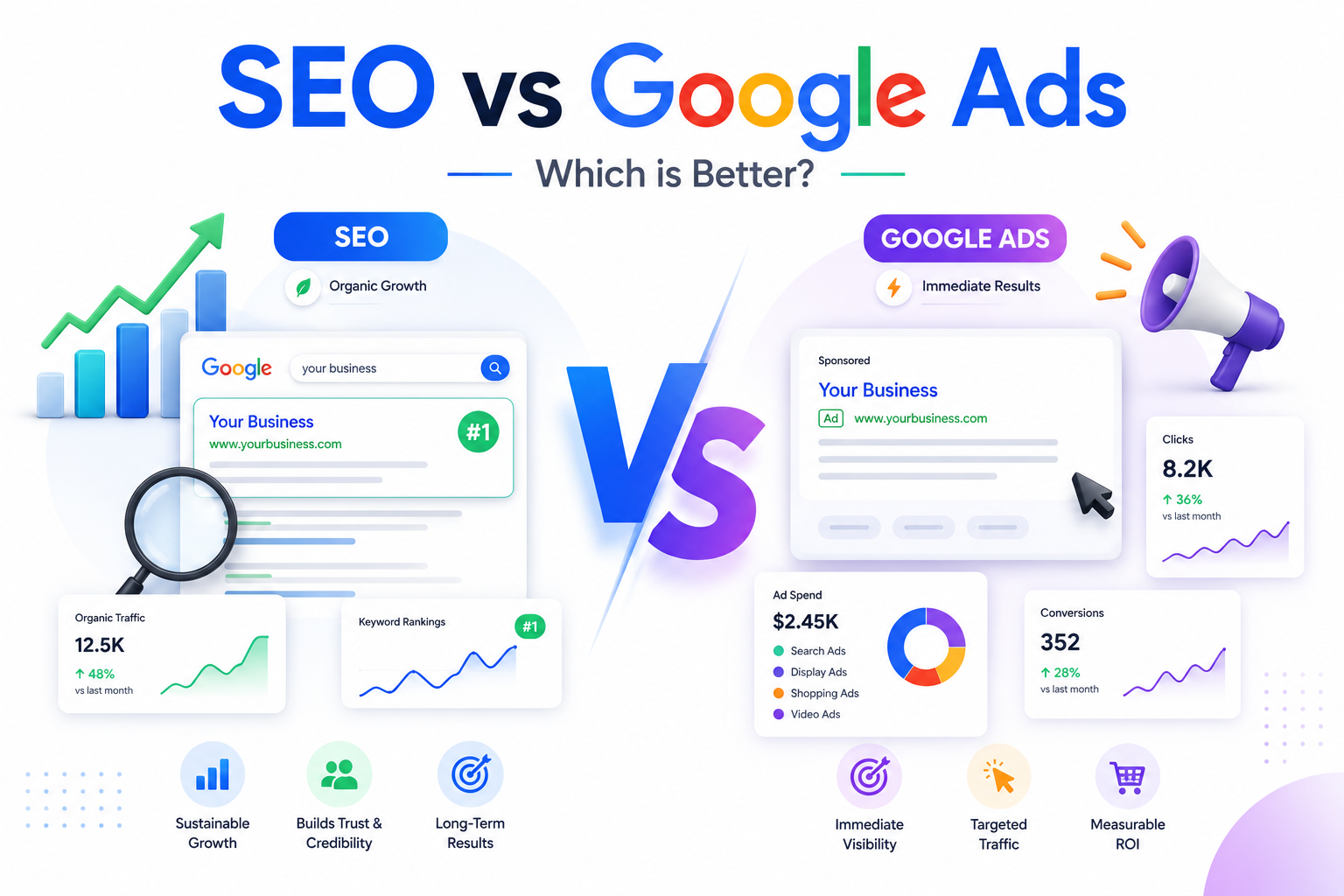
When someone searches for a service or product on Google, two types of results show up: paid ads at the top (clearly labeled) and organic results below them.
Google Ads puts your business in those paid spots. You set a budget, choose keywords, and pay each time someone clicks your ad. Stop paying, and your listing disappears.
SEO — search engine optimization — is about earning a spot in the organic results through the quality and relevance of your website content. It takes longer to see results, but once you're ranking, that traffic doesn't cost you per click.
Same goal. Very different paths to get there.
2. SEO vs Google Ads: A Side-by-Side Comparison
| Factor | SEO | Google Ads |
|---|---|---|
| Cost Structure | Investment in content and optimization | Pay for every click or impression |
| Speed of Results | Usually takes months | Can generate traffic almost immediately |
| Long-Term Value | Continues generating traffic over time | Traffic stops when spending stops |
| Trust Factor | Often perceived as more credible by users | Clearly labeled as advertisements |
| Scalability | Grows gradually over time | Can scale quickly with budget increases |
| Competition Impact | Requires ongoing optimization to maintain rankings | Higher competition typically raises cost per click |
3. When SEO Is the Better Choice
You Want Sustainable Long-Term Growth
SEO compounds. A blog post or service page that ranks well today can keep bringing in visitors six months or two years from now — without you paying for each visit. That's not true of paid ads. The moment you stop funding a campaign, the traffic stops with it.
For businesses thinking about where they want to be a year or two from now, SEO builds something that lasts.
You Want to Reduce Dependence on Paid Traffic
Running ads indefinitely is expensive. Many businesses use Google Ads as a starting point but eventually want organic traffic to carry more of the load. SEO gives you a path to reduce what you're spending on ads over time.
You Have Time to Build Organic Visibility
SEO isn't slow because it's inefficient — it's slow because Google needs time to evaluate your site's credibility and relevance. If you have a few months before you need results and a consistent plan, SEO pays off well.
You Want to Establish Authority and Trust
Customers searching Google often scroll past ads and go straight to the organic results. Appearing there — especially consistently across different searches — signals that your business is established and trustworthy. That kind of credibility is harder to buy than it is to earn.
4. When Google Ads Is the Better Choice
You Need Traffic and Leads Quickly
If you need inquiries this week, not this quarter, Google Ads is the faster route. A well-set-up campaign can start showing your business to potential customers the same day it goes live. SEO doesn't work that way.
You're Launching a New Product or Service
When something new launches, there's no existing content or domain authority to fall back on. Google Ads fills that gap — you can get visibility immediately while organic rankings build in the background.
You Want to Test New Markets and Offers
Ads give you fast feedback. You can test different messages, different services, and different cities before committing to a longer-term strategy. If an ad campaign generates zero inquiries, that tells you something important quickly. SEO takes much longer to give you that kind of signal.
You Need Immediate Visibility for High-Intent Searches
Some searches — like "emergency electrician" or "same day flower delivery" — are made by people ready to act right now. Appearing at the top of those results immediately through ads can be worth the cost if the job value is high enough.
5. Which Delivers Faster Results?
Google Ads wins on speed, and it's not close. A campaign can be live and generating clicks within hours of setup. For businesses that have a clear offer and a budget to work with, that kind of immediacy is genuinely useful.
SEO takes longer. Most businesses start seeing meaningful organic traffic improvements three to six months into a consistent SEO effort — sometimes longer, depending on the competitiveness of the keywords and the current state of the website. But the trajectory matters: SEO results tend to build on themselves. Rankings that improve over time stay improved, and the traffic they generate doesn't come with a monthly invoice.
6. Which Is More Cost-Effective in the Long Run?
This depends on timeframe, and most comparisons get it wrong by not being specific about that.
In the short run, Google Ads can be more cost-effective — you pay for targeted traffic immediately and can control exactly how much you spend. SEO requires investment in content creation, technical improvements, and time before you see returns.
Over a longer period — say, 12 to 24 months — the math often shifts. A business that has invested in SEO and earns consistent organic traffic is spending far less per lead than one relying entirely on paid ads. The cost per click on Google Ads also tends to rise over time in competitive markets, which makes organic visibility increasingly valuable as the years go on.
"Cheaper" is the wrong question. The better question is: what does each approach cost relative to what it produces, over the timeframe that matters to your business?
7. Which Builds More Trust With Potential Customers?
Studies consistently show that a meaningful portion of search users skip the paid ads entirely and go directly to organic results. The label "Sponsored" does affect how some people perceive those listings — particularly for health, financial, and professional service searches where trust matters most.
That said, it's not universal. For product searches or local service searches where intent is clear, ads perform well and customers don't hesitate to click them. The trust dynamic shifts depending on what someone is searching for and how they've learned to use Google.
Organic rankings tend to carry more implied credibility, but the extent to which that matters varies by industry. A law firm or a medical practice may benefit significantly from organic authority. A flower shop running a Valentine's Day promotion probably doesn't need to worry about it.
8. A Real-World Example: SEO vs Google Ads for a Local Business
A plumbing business in a mid-sized city wants more leads from Google. Here's how each approach plays out:
Using Google Ads: The business sets up a campaign targeting searches like "plumber near me" and "emergency pipe repair." Within a few days, the ads are live. If the campaign is set up well, calls start coming in. The business pays for each click — anywhere from a few hundred to several thousand rupees per lead depending on competition. The moment the campaign pauses, the calls from Google stop.
Using SEO: The business works on improving its website, gets listed properly on Google Business Profile, builds some local citations, and publishes content around common plumbing questions. Three to four months in, the site starts ranking for local searches. The leads that come in from those rankings don't cost per click. After 12 months, the organic traffic is generating a steady stream of inquiries that continues even without active ad spend.
The difference is timing and sustainability. Ads give you reach immediately. SEO gives you reach that stays.
9. Can SEO and Google Ads Work Together?
They can, and for many businesses, running both simultaneously is the strongest approach — not because it covers all bases for the sake of it, but because each one fills a genuine gap the other has.
Use Google Ads for Immediate Traffic
While your SEO is building, ads keep leads coming in. This is especially useful in the first six to twelve months of a business, or after launching something new.
Use SEO for Sustainable Growth
As organic rankings improve, you can reduce ad spend on keywords where you're already ranking well. The budget you free up can go toward campaigns on competitive terms where organic rankings are harder to achieve.
Use Insights From Ads to Improve SEO Strategy
Ad campaigns tell you which keywords actually convert — not just which ones get clicks, but which ones lead to phone calls, form fills, and sales. That data is directly useful for deciding which pages to build and which topics to focus on for SEO.
Build a Balanced Customer Acquisition System
Relying on a single source of traffic is a risk. Algorithm changes can affect organic rankings. Ad costs can spike. Businesses that have both working tend to be more resilient to either disruption.
10. So, Which Is Better for Your Business?
Neither is universally better. It comes down to where your business is, what you need, and how much time you have.
- Are building toward consistent organic growth over the next one to two years
- Want to reduce dependence on paid advertising
- Have the patience and resources to invest in content and technical improvements
- Operate in a space where credibility and trust matter to buyers
- Need leads and inquiries quickly
- Are promoting something time-sensitive or newly launched
- Have a clear budget and want predictable, controllable traffic
- Are testing whether a market or offer is viable
- Want to cover both the short term and the long term
- Are in a competitive market where organic rankings take time but customers are searching now
- Have the budget to run campaigns while building organic presence in parallel
11. Frequently Asked Questions
Is SEO better than Google Ads?
Neither is objectively better — they serve different purposes. SEO builds organic visibility over time and doesn't require paying for each visitor. Google Ads gets you visible immediately but stops working the moment you stop spending. Which is better depends on your timeline, budget, and goals.
Does Google Ads help SEO rankings?
No. Running Google Ads doesn't improve your organic search rankings. Google keeps paid and organic results separate, and spending on ads has no direct effect on where your website appears in organic results.
Which is cheaper: SEO or Google Ads?
In the short term, Google Ads gives you faster returns on your investment, which can make it feel more cost-effective initially. Over a longer period, SEO tends to produce a lower cost per lead because you're not paying for every visitor. The honest answer is that it depends on your timeframe and how competitive your market is.
Can a small business rely only on SEO?
Yes, but it requires patience. Many small businesses do generate the majority of their leads from organic search without running paid ads. The key is consistency — maintaining the website, keeping content updated, and building local authority over time. The results take longer to arrive but can be very sustainable.
Should new businesses start with SEO or Google Ads?
Most new businesses benefit from starting with Google Ads to generate leads quickly while simultaneously laying the groundwork for SEO. Waiting six months for organic rankings to kick in isn't realistic for a business that needs customers now. Over time, as the site builds authority, the balance can shift toward organic.
12. Final Thoughts
SEO and Google Ads aren't really competing against each other — they're just different tools for achieving the same outcome, on different timelines and with different cost structures.
Google Ads is useful when speed matters. SEO is useful when durability matters. For many businesses, the strongest position is one where both are working, each filling the gap the other has.
The right choice for you comes down to how soon you need results, what you can invest, and whether you're thinking in months or years. Getting clear on those three things makes the decision much easier.
Scale Your Traffic and Leads with AMVIZ Digital
Our search marketing specialists build optimized SEO architectures and high-ROI Google Ads campaigns tailored to your business.